Showing posts with label Federal Reserve. Show all posts

Friday, February 27, 2009

Tracking the Recession

The Saint Louis Fed recently created a brief report that tracks the current recession via the behavior of GDP components and four economic indicators: industrial production, real income, employment, and real retail sales.

The report graphs multiple business cycles, by aligning the months in which each business cycle peaked. This allows you to compare the months leading up to, and following, peaks in the business cycle. In addition to the current series values, the average, highest, and lowest series values are displayed.

During this recession, the US has experienced the worst declines in industrial production and real retail sales, and is close to showing the worst decline in employment.


Industrial Production Real Income
Employment Real Retail Sales


The GDP numbers do not appear quite as dire. Personal consumption expenditures are showing a historically severe decline, which aligns with the real retail sales data. Real imports have also shown a significant decline during this recession.


Real Gross Domestic Product Real Personal Consumption Expenditures
Real Gross Private Domestic Investment Real Govenment Consumption Expenditures and Gross Investment
Real Exports of Goods and Services Real Imports of Goods and Services

Wednesday, November 26, 2008

10-year Treasury at 2.995%

The 10-year Treasury briefly dipped below 3% this morning. Is this a reflection of fear, deflation, or a result of all the money being poured into the system over the past few months?

Wednesday, October 29, 2008

Fed Holds Rates Steady

The opening sentence of today's FOMC statement reads:

The Federal Open Market Committee decided today to lower its target for the federal funds rate 50 basis points to 1 percent.
Decided today, really? By looking at the effective federal funds rate, it looks like this policy action was decided two weeks ago.

Wednesday, October 22, 2008

September Inflation

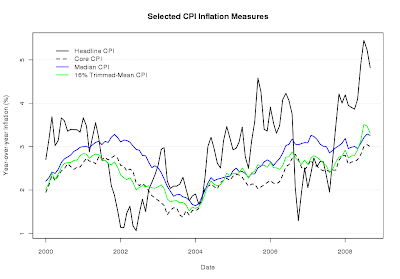
The chart below shows headline and core CPI have climbed sharply since mid-2006. Headline CPI is currently near 5% year-over-year, while all measures of core CPI are at 3%.

Why, even though inflation is high and has been increasing, does the Fed consider inflation expectations to be contained? The Fed noted the fall in commodity prices, which will dampen inflation in coming months, in their October 8th statement. They also noted inflation expectations have diminished.

The following chart shows inflation expectations via the spread between the 10-year constant maturity Treasury rate and the corresponding TIPS rate. Expectations currently stand at an average of 1% per year for the next 10 years. I seriously doubt this will be realized; it's more likely a function of the current market pessimism.


Two important caveats: (1) the spread has two components - expected inflation and inflation risk premium, and (2) TIPS yields have a liquidity premium. Given the short-term nature of our comparison, neither of these caveats should be too problematic.

Wednesday, October 8, 2008

Surprise Fed Cut

From this morning's press release:

Inflationary pressures have started to moderate in a number of countries, partly reflecting a marked decline in energy and other commodity prices. Inflation expectations are diminishing and remain anchored to price stability. The recent intensification of the financial crisis has augmented the downside risks to growth and thus has diminished further the upside risks to price stability.

Some easing of global monetary conditions is therefore warranted. Accordingly, the Bank of Canada, the Bank of England, the European Central Bank, the Federal Reserve, Sveriges Riksbank, and the Swiss National Bank are today announcing reductions in policy interest rates. The Bank of Japan expresses its strong support of these policy actions.

Federal Reserve Actions
The Federal Open Market Committee has decided to lower its target for the federal funds rate 50 basis points to 1-1/2 percent. The Committee took this action in light of evidence pointing to a weakening of economic activity and a reduction in inflationary pressures.
The futures market initially shot up in response to this news. Within an hour, however, they had fallen back to their pre-release levels. Perhaps the market realized this crisis has not been due to restrictive monetary policy, but rather deleveraging of financial institutions and ignorance of where those institutions' risk lies.

The spot markets gapped slightly lower but have been making gains since the open.

Saturday, September 20, 2008

Botched Bailouts

I've been following the government's many recent financial bailouts (Fannie and Freddie, AIG) and interventions (Term Lending and Auction Facilities, short selling rules, RTCII) fairly closely.

There has been much discussion of how deregulation of the financial industry lead to this crisis - especially in the case of the (former) five firms that 'enjoyed' net capital exemptions from the SEC - and how the government's recent actions smack of socialist policies.

Until Friday, I had not read anything about how these actions may have exacerbated the financial crisis. Jim Jubak does a superb job of outlining how these rescues have actually made some things worse. The whole article is worth reading, but the highlights are below.

[I]n the name of creating an orderly liquidation of a company such as Lehman Bros., they create a mad scramble to get paid before the bankruptcy court can act.

By wiping out the Fannie Mae and Freddie Mac preferred stock, the Fed and Treasury killed off any possibility that some other financial institution in need of capital could raise cash by selling these dividend-paying shares.

[T]he Treasury and Fed have ensured that no conservative, income-seeking investor in his or her right mind would buy preferred stock from a troubled financial company looking for capital.

After drawing a line in the sand and saying no more bailouts, the Fed and Treasury ponied up $85 billion in taxpayer cash to go into the insurance business. Their excuse for the about-face: Though the Fed had planned for a Lehman bankruptcy, it hadn't modeled a failure at AIG and couldn't predict the consequences of letting the company go into bankruptcy. That's not reassuring.
Source:
Botched rescues are killing markets
Jubak's Journal 9/19/2008 12:01 AM ET

Tuesday, March 4, 2008

January Inflation Reports

The inflation numbers for another month are in, and the results do not look very good. The charts and brief commentary below summarize the changes.

Today Calculated Risk noted that, "inflation expectation have surged recently." They cite a Bloomberg article that charts the spread between the 5-year TIPS and the 5-year Treasury. You can find an interactive chart of the spread between those two rates on the Cleveland Fed's website.

At this point, I think it's safe to say that - contrary to what the FOMC has to say - both inflation and inflation expectations are not well contained.


Annual core PPI inflation has moved from its 2006 lows near 1% to hovering above 2% in the second half of 2007.

Core PCE inflation has jumped back above 2% and trimmed-mean PCE inflation is nearing 2.5%.

CPI inflation is worst of all; core is near 2.75%, 16% trimmed-mean is approaching 3%, and the median CPI is closing on 3.25%.

Wednesday, January 23, 2008

Surprise!

The Fed's inter-meeting 75 bps cut yesterday came as a complete surprise (at least to me). I've previously noted that Fed Funds expectations were for a 50-75 bps cut at the next meeting on January, 29-30.

The statement cited a weakening economic outlook, increasing downside risks to growth, continued deterioration in broader financial markets, tightening credit for some businesses and households, and a deepening housing correction as the reasons for the target rate change.

That said, what's the point of cutting rates inter-meeting a week early? One week will hardly make a difference, given the lag of monetary policy. My only hypothesis is that the FOMC had already been discussing the action - which was mostly based on economic conditions - and they released the statement early, in response to overseas and overnight US futures trading. However, that begs the question of why the FOMC was swayed by equity market conditions.

In addition, and possibly more interestingly, Fed Fund futures still assign a 40% probability of the FOMC cutting another 25 bps next week...

Sunday, January 20, 2008

Monetary and Fiscal Stimulus

There was plenty of talk about fiscal stimulus packages last week. The White House wants tax cuts to help a wide range of individuals and businesses. Privately, it has floated a plan that focuses on rebates of up to $800 for individuals and $1,600 for married couples.

In addition to tax cuts, congressional Democrats say they also want spending targeted at specific groups such as the unemployed. They have also discussed denying rebates to taxpayers who earn more than $85,000 and offering them to those who don't pay income taxes at all.

Despite the market's disappointment, the plan President Bush announced Friday, which is equivalent to about 1% of gross domestic product, came in at the high end of expectations in Washington.

In addition, Fed Funds futures and options show a 40% probability of 50 and 75 bps cuts, and almost a 20% probability of a 1% cut. The jump in the odds of a 75 bps cut was near Bernanke's speech on 1/11 and the wholesale trade and retail sales reports. The probability of a 1% cut increased near the consumer sentiment report and Bernanke's Congressional Testimony.

None of this will ward off a recession in the United States. The slowdown in growth isn't purely a liquidity problem. It's a confidence problem causing a lack of liquidity. Banks won't start lending to one another again until they have a better idea of who owes what. Until then they're going to continue to horde cash to shore up their balance sheets to prepare for the worst.

Further, this isn't just a subprime or even a mortgage problem (we have yet to even reach the pinnacle of the option ARM wave). Issues are beginning to surface in the commercial real estate, auto loan, and credit card secondary markets. Who knows what other credit products will follow?

The actions of the Fed and Washington won't stop the stock market's decline, or the oncoming/current recession, since this current slowdown is a confidence problem, not a liquidity/stimulus problem. And, unfortunately, the problem is likely to get worse before it gets better.

I expect the market to slowly work its way up - with a few relief/short-squeeze rallies - over the next week or two, sending major indices near their August lows (about a 5-6% gain from Friday's close). I will enter a short position in the NASDAQ 100 and/or Russell 2000 near the August lows if they are attained before the Fed meeting next week, since I expect the catalyst to the next major move down to be the outcome of the meeting.

Monday, December 17, 2007

Too Little, Too Late

According to a CNN Money article, the Fed is expected to propose rules to crack down on mortgage lending tomorrow. Some examples of the rules being considered are (emphasis mine):

  • barring lenders from penalizing subprime borrowers - those with spotty credit or low incomes - who pay their loans off early.
  • forcing lenders to make sure that borrowers, especially subprime borrowers, set aside money to pay for taxes and insurance.
  • restricting loans that do not require proof of a borrower's income.
  • examining lenders' failure, in some cases, to consider a borrower's ability to repay a home loan.
  • improving financial disclosure so people better understand the terms and conditions of their mortgages and get this information when it is most useful.
  • curtailing abuses in mortgage advertising.
All of these were obviously needed years ago, especially the point in bold. Probably most stated-income loans made in the past couple years should have never been originated. I say 'most' because these loans are legitimate for some borrowers, e.g. the self-employed.

It is beyond me why the Fed did not address this practice until now. How could they not know these loans were being mis-used, when it's their job to regulate the financial system?

Not only are these rules too little, too late - the market is currently addressing some of them. To ask a rhetorical question, how many lenders are currently originating sub-prime or stated-income loans?

While these rules are necessary, they will do nothing to help the current mortgage-induced liquidity crisis.

Source:
Fed to crack down on shady lenders
WASHINGTON (AP), 12/15/2007 12:08 PM ET

Thursday, December 13, 2007

All in One Day

The following post is courtesy of Ryan, my good friend and fellow market-watcher. We regularly discuss the stock market. Below he provides his unique insights on today's (yesterday's) market action. So, without further ado...

I've been in banking for 7 years. I spent the first 4 years picking stocks for mutual funds, and worked on a trade desk the first 2 of those years. Those were really fun days in 2001 and 2002. Amongst other things, I witnessed the dot-com bubble burst, the first surprise rate cut by the Fed (a non-meeting 50bps cut), and Sept 11 - all from a unique perspective.

The last 3 years I've worked on the mortgage side, with the last year and half with Josh in capital markets. I have continued to follow the stock market the entire time. What is so amazing about today is that I can't remember a day quite like it. I remember many days when the market opened high, stayed high all day, and then gave back everything in the last hour... but that's nothing like today.

To put it into perspective (I'm going to use the Wilshire 5000 to represent the total market, though I'm sure you can pick any index and get a similar story):

Open: 14,923.64
9:15 AM: 15,256.52
3:15 PM: 14,820.01
3:45 PM: 14,999.82
Close: 14,994.54

The market deflated like a tire with a slow leak between 9:15 and 3:15. I can't remember such a slow, steady, uneventful decline after a strong opening during one trading day. It was really amazing to watch.

For those keeping count, the first 15 minutes returned 2.23%, or approx. 0.15% a minute. For the next 5 hours of trading, the market gradually worked its way to a -0.69% return on the day (the market's low point). The amazing thing is that anybody who bought the market at 9:15 AM had lost 2.86% in 5 hours (or -0.0095% a minute). So, they were giving away 1 minute of gains from the morning's rally every 15 minutes and 30 seconds that passed after that peak.

But the market wasn't done; then it rallied for another gain of 1.21% at the peak around 3:45 PM. That's a gain of of 0.04% a minute. The VIX showed this as the period with the greatest amount of volatility. The market finally closed with a gain 0.47% on the day.

To summarize: you have a gain of 2.23%, loss of 2.86%, gain of 1.21%... IN ONE DAY!!! If you told me these were market returns, I would tell you that was 3 separate days of activity. But nope, it happened in one day.

Today's market behavior underscores investors' ignorance of the depth and magnitude of the credit crunch. Five of the largest central banks were effectively forced to work together, and that's something to cheer about? Ironically, not long after the central banks' announcement, Wachovia and Bank Of America both issued additional warnings on their exposure. Its like the market was cheering "Yeah, they're going to get us out this mess," and then screaming "OH NO!!! THE MESS!!!".

As I write this, the Nikkei is down 1.51% (its lunch time over there right now). I guess they don't think much of the worlds' central banks' coordinated efforts either.

Thursday, December 6, 2007

The USD and EU Inflation

Jim Jubak wrote a great piece on the woes of the USD this past Tuesday. The article focuses on inflation in the European Union affecting the USD. The entire article is worth reading, but I highlight a very significant portion below.

I'll admit I don't know what the two banks will decide Thursday and Dec. 11. But I do know what will happen if the interest-rate gap between the two currencies shrinks further:
  • The U.S. dollar will fall, and the euro will climb.
  • The price of oil, which trades in U.S. dollars, will go up again, as oil producers adjust prices so that they at least break even on the dollar's decline.
  • Gold prices will climb as investors seek an alternative to the U.S. dollar as well as safety from uncertainty about the global economy and a likely bump in U.S. inflation.
  • U.S. equities will rally in the days after a Federal Reserve rate cut but then give much of the gains back as overseas investors pull money out of the U.S. financial markets in response to the dollar's weakness.
Today the ECB held their target rate at 4.0% instead of raising it, as Jim anticipated. The overnight interest rate spread between the US and EU remains 50 bps (instead of falling to 25 bps if the ECB had raised their rate). That may give the Fed a bit more breathing room to cut by 50 bps instead of 25.

As of today, the Fed Funds Futures market expects a 60% probability of a 25 bps cut and a 30% chance of a 50 bps reduction using January options (click for image). Using December options, the expectation is about 50% for both 25 and 50 bps reductions. You read that correctly, nearly a 100% expected probability of a rate cut.

Source:
The dollar's perfect storm worsens
Jim Jubak
Jubak's Journal, 12/4/2007 12:01 AM ET
http://articles.moneycentral.msn.com/Investing/JubaksJournal/TheDollarsPerfectStormWorsens.aspx

Sunday, November 18, 2007

October Inflation Reports

Both PPI and CPI inflation reports were released last week. PPI came in below expectations, while CPI was in line with the consensus estimate.

The chart below shows both headline and core PPI near the top of their range since 2000. Further, PPI inflation has been increasing since mid-2006. This doesn't bode well for moderating CPI inflation, if PPI leads CPI.


As expected, there was a sharp increase in YOY headline CPI inflation in October, while CPI inflation ex food and energy remained near 2.5%. In this week's Thoughts From the Frontline, John Mauldin shows YOY headline CPI inflation will remain high for the rest of 2007, due to last year's low index levels. He also describes the changes made to the CPI index in the early 1990's (substitution and hedonics).

The chart below shows two lesser-known 'core' measures of CPI inflation created by the Cleveland Fed. Both the median and trimmed-mean CPI show an increase in October. Further, Mauldin's analysis suggests we should expect these two core measure to increase in the next two months.


While the Fed doesn't have explicit inflation targets, it's believed 1-2.5% is in their comfort range for core PCE inflation. All three measures of core CPI inflation shown above are at or near 2.5%. As many have noted, this doesn't leave the Fed much room to cut thier target rate if the economy begins to slow substantially.

Tuesday, September 18, 2007

Inconsistent Market Response to Inflation

The PPI released this morning showed headline inflation much below forecast, due to falling energy prices; but core PPI was higher than forecast. Stock futures markets rallied on the news. This is completely inconsistent with prior month's releases, when the markets rallied on relatively high headline readings because core inflation was at or below expectations.

It would seem that greater than expected PPI inflation, which also remains above the Fed's supposed comfort range of 1-2% year-over-year, would lessen the probability of the 50 bps rate cut the market's been hoping for.

UPDATE: It appears that some or all of the futures rally could be attributed to Lehman's earnings report. Even so, the PPI report didn't evoke any negative reaction.

Wednesday, July 11, 2007

Bernanke Speech : 07-10-2007

This Tuesday, Ben Bernanke spoke to the NBER-sponsored Summer Institute regarding inflation expectations and inflation forecasting. On inflation expectations, Bernanke summarized recent literature focusing on defining and measuring inflation expectations, and how to use that information to forecast and control inflation.

The more interesting part of the speech concerned how the Federal Reserve Board forecasts inflation. Rather than recapitulating the most intriguing portion, I've included it below:

The Board staff employs a variety of formal models, both structural and purely statistical, in its forecasting efforts. However, the forecasts of inflation (and of other key macroeconomic variables) that are provided to the Federal Open Market Committee are developed through an eclectic process that combines model-based projections, anecdotal and other "extra-model" information, and professional judgment. In short, for all the advances that have been made in modeling and statistical analysis, practical forecasting continues to involve art as well as science.

The forecasting procedures used depend importantly on the forecast horizon. For near-term inflation forecasting--say, for the current quarter and the next--the staff relies most heavily on a disaggregated, bottom-up approach that focuses on estimating and forecasting price behavior for the various categories of goods and services that make up the aggregate price index in question. ... In making very near-term price forecasts, the staff also uses diverse information from a variety of sources, such as surveys of prices of gasoline and other important items, news reports about price-change announcements, and anecdotal information from our business contacts. Conceptually, one might think of this effort to distinguish transitory from persistent price changes as a more nuanced way of estimating the underlying inflation trend, analogous to the trend measures provided by more mechanical indicators such as trimmed-mean or weighted-median inflation rates.

An accurate forecast of very near-term inflation is important not only for its own sake but also because it provides a better "jumping-off point" for the longer-term forecast. Because inflation continues to exhibit some inertia, improved near-term forecasts translate into more-accurate longer-term projections as well.

For forecasting horizons beyond a quarter or two, detailed analyses of individual price components become less useful, and thus the staff's emphasis shifts to inflation's fundamental determinants. Food and energy inflation are forecasted separately from the core, using information from futures prices and other sources. However, forecasts of core inflation must take into account the extent to which food and energy costs are passed through to other prices.

In addition to the above, Bernanke notes that the Board uses a range of econometric models to forecast inflation at longer horizons. However, the models' estimates are not so robust as to permit sharp inferences, so the Board's long-term forecasts "inevitably reflect a substantial degree of expert judgment and the use of information not captured by the models." Finally, he turns to the Board's use of inflation expectations in forecasting inflation.

Saturday, June 9, 2007

Is Inflation Moderating?

Beginning with the March, 2007 FOMC statement, the Fed has stated that its primary concern is that inflation will not moderate as expected. The FOMC statement and minutes from the May, 2007 meeting and a CNBC interview with Chicago Fed President Michael Moskow on Friday reiterate this concern.

This suggests the inflation measure(s) the FOMC consults when determining monetary policy are at the upper end of their (collective) comfort range. The two charts below (click for larger image) show headline/core CPI and PCE inflation from 2000 to the present. Contrary to traditional headline/core inflation measures, the core inflation measures created by two regional Federal Reserve Banks show that inflation has not fallen from its levels of 2005 through early 2006.


Both year-over-year CPI and PCE headline inflation have decreased significantly from their levels of 2005 through early 2006. Compared to the same historical period, both measures of PCE core inflation have barely budged, and all measures of CPI core inflation have risen.

Both the PCE less Food & Energy and the Dallas Fed's Trimmed Mean PCE inflation measures have declined slightly since their respective peaks in late 2006. The Trimmed Mean PCE has fallen slightly less, however. Also worth noting, the spread between PCE less Food & Energy and Trimmed Mean PCE seems to be a pretty steady 20-30 bps.

CPI inflation is more interesting. CPI less Food & Energy inflation has fallen from its late-2006 peak of nearly 3% to less than 2.3% in April, 2007. However, 16% trimmed mean inflation has only fallen from 2.9% to 2.75% over the same period. Further, median CPI inflation remains near its levels (3.5%) of late 2006.

Moskow said, "The last quarter, GDP growth was very low – six-tenths of a percent. That’s history now. This quarter should be much stronger and, as we move through this year into next year, I see us moving toward potential growth, or long-term trend growth, in the economy." But if productivity continues falling and wage growth continues accelerating, I'm not sure what the Fed expects will contain inflation pressures. Then again, maybe that's why the FOMC's primary concern is inflation failing to moderate as desired...

I'll provide an update when May's CPI data come out on 6/15.

Thursday, June 7, 2007

Inflation and the Fed

In this morning's commentary on The Big Picture, Barry Ritholtz writes:

Of course, many pundits, traders and investors -- and a goodly part of the Federal Reserve -- have convinced themselves that there really wasn't any inflation, ...

I agree with Barry regarding the many pundits, traders, and investors that have convinced themselves that there really wasn't a reason to worry about inflation (just look at the stock market action of the past few months), but I disagree that many Federal Reserve policy-makers are not concerned about inflation.

I know I've said it before on Barry's blog, but I'll say it again here: I worked at a Federal Reserve District Bank in 2004-05 as an economic research analyst - assisting the economists with their research.

There was much discussion regarding the measurement error of core CPI beginning in early 2005. That's about the time the Cleveland Fed came out with their median CPI measure, and the Dallas Fed - whose head of research is mentioned in Barry's post - created their trimmed mean PCE measure. Furthermore, the FOMC minutes have stated for some time that the main concern of the Fed is that inflation will fail to moderate as expected (i.e. inflation - by whatever measure they're now using - is above their comfort zone).

I'm not aware of the evidence Barry has seen that suggests that a good part of the Federal Reserve have convinced themselves that there is no inflation. One could argue that - given inflation data - the Fed should raise rates, but this is what is discussed/argued in FOMC meetings.

UPDATE:
Here's an interesting excerpt from the Reuters article referenced in Barry's post:
On the other hand, Rosenblum said that because the Fed relies on a number of different measures of price pressure, there was not much risk the flaws in core inflation would translate into a policy mistake.

"The fact that core is misbehaving now because food and energy are moving in one direction instead of up and down is not all that troublesome to me because we have the good sense to look at the wide range of indicators out there," he said.

Wednesday, May 30, 2007

FOMC Minutes : 05-09-2007

I think the following paragraph is the largest take-away from the FOMC minutes released this afternoon (all emphasis mine).

In the Committee's discussion of monetary policy for the intermeeting period, all members favored keeping the target federal funds rate at 5-1/4 percent. Recent developments were seen as supporting the Committee's view that maintaining the current target rate was likely to foster moderate economic growth and a gradual ebbing in core inflation. Members continued to view the risks to economic activity as weighted to the downside, although with turmoil in the subprime market appearing to have remained relatively well contained and business spending indicators suggesting a more encouraging outlook, these downside risks were judged to have diminished slightly. Members agreed that considerable uncertainty attended the prospects for inflation, and the risk that inflation would fail to moderate as desired remained the Committee's predominant concern.
I'm anxious to see how Fed Funds Futures will react to this release.